
RCG Health TReatments
Summary
Abdominoplasty, commonly known as a tummy tuck, is a surgical procedure designed to remove excess skin and fat from the abdomen. It also allows for the tightening of the abdominal muscles and the improvement of abdominal contours and scars. Various techniques may be used depending on the individual patient’s needs.
Types of Abdominoplasty Procedures
Standard Abdominoplasty
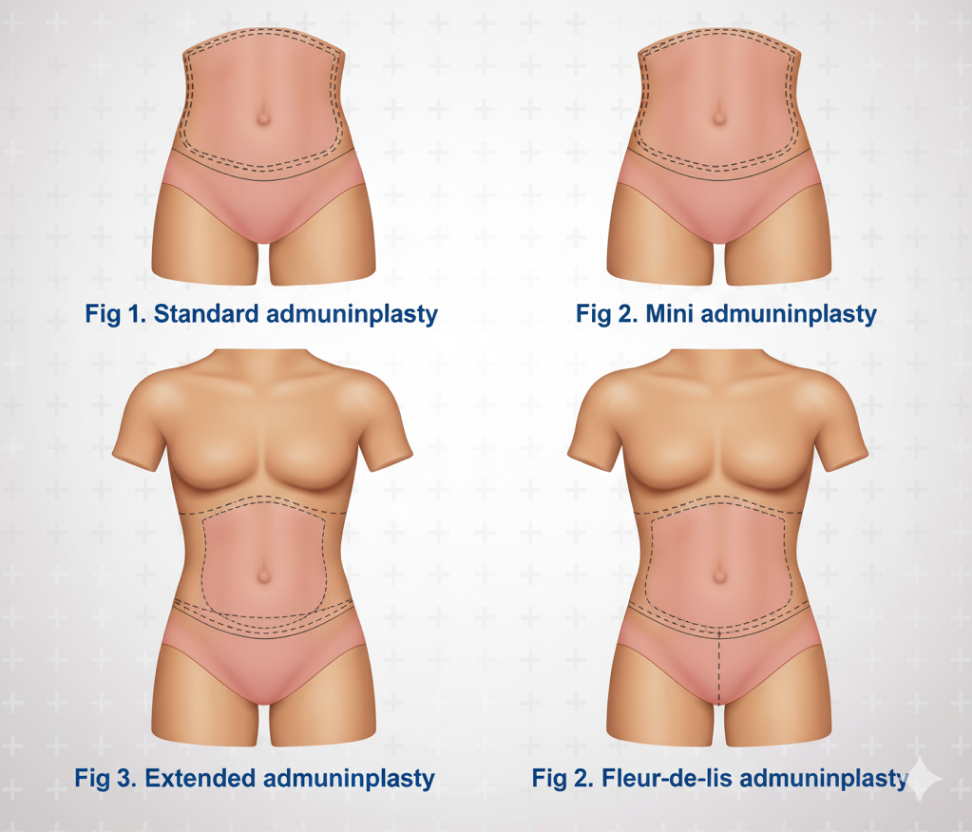
Removes the excess skin and fat between the pubic area and the umbilicus (navel). The remaining skin is pulled down and sutured at the public level. This results in a curved scar across the lower abdomen and another around the umbilicus. Muscle repair or hernia correction is performed if needed. The patient is left with a long, usually curved scar across the lower part of the abdominal wall at the level of the pubic hair. There is also a scar around the umbilicus – see Fig. 1. Liposuction may be carried out during this procedure or as a separate procedure, either before or after the abdominoplasty.
High Lateral Tension Abdominoplasty
A variation of the standard procedure that involves preserving the umbilicus as a ‘floating umbilicus’ without a scar around it.
Mini-Abdominoplasty
It removes a smaller amount of skin just above the pubic area, resulting in a shorter, lower-lying scar. The umbilicus is left untouched—see Fig. 2.
Extended Abdominoplasty
It removes excess skin and fat from the loins and back, extending the scar around the flanks onto the lower back (see Fig.3).
Fleur-de-lis Abdominoplasty
Is an extended abdominoplasty where an additional vertical ellipse of skin and fat is removed, resulting in a scar extending from the breastbone to the horizontal lower abdominal scar – see Fig 4
Apronectomy
It is intended for patients who require the removal of a large, hanging apron of skin and fat over the pubic area, typically after significant weight loss. The umbilicus is often removed.
‘Lock and Glue Lipo-abdominoplasty’
An innovative technique, described by Mrs. CC Kat in 2010 and awarded for its excellence, locks and glues the skin flap to reduce dead space, minimise fluid accumulation, eliminate the need for drains, and whilst enhancing contour or definition.
Liposuction Alone
Sometimes, it is used as an alternative to surgery to reduce fat and modestly tighten the skin.
Suitability for Surgery
Ideal candidates include those with:
- Excess skin and fat in the abdominal area
- Weakness or separation of abdominal muscles (e.g., post-pregnancy diastasis)
- Stable weight and BMI under 30
Skin removal often reduces stretch marks on the lower abdomen and may appear less prominent after surgery. Smokers and those with a BMI over 30 are advised to delay surgery due to increased risk.
Risks and Limitations
- Visible scarring – the location and quality vary; vertical scars are generally less favourable.
- Temporary numbness and swelling.
- Delayed wound healing, particularly in smokers and overweight patients.
- Risk of blood clots (deep vein thrombosis or pulmonary embolism).
- Unsatisfactory outcomes – revision procedures such as scar revision or additional liposuction may be required.
Tightening the waist may require additional procedures. Standard abdominoplasty primarily tightens the skin downwards and does not significantly contour the waist. If waist tightening is desired, vertical skin excision can be considered; however, vertical abdominal scars are typically less aesthetically favourable.
Without liposuction, a fatty bulge may persist above the scar, as abdominal wall tissue is generally thicker than the groin area.
The results of surgery are long-lasting but are best maintained with regular exercise and stable weight. Future pregnancies can stretch the skin again, although usually to a lesser degree than before surgery.
Patients with a BMI over 25 may achieve less optimal results due to thicker skin flaps and greater intra-abdominal fat.
Patients with a BMI over 30 are generally advised to lose weight before undergoing surgery.
Smoking is an absolute contraindication, due to its significant impact on wound healing and overall surgical outcomes.
Pre-Operative Instructions
- Begin taking Arnica tablets (2 tabs three times daily) two weeks before and after surgery.
- Avoid aspirin, ibuprofen, and similar medications one week before and two weeks after surgery.
- Discontinue taking Vitamin E, evening primrose oil, fish oil, and garlic supplements at least one week before surgery.
- Cease the contraceptive pill and HRT four weeks pre-op.
- Shower with Hibiscrub (provided) the day before and the morning of surgery.
- Wear a firm, cotton, high-waisted support garment (e.g., from Marks & Spencer).
- Wear loose, front-opening clothes to the hospital (drawstring bottoms for men).
Post-Operative Instructions
Compression & Dressings
- Wear a compression garment day and night for 2 weeks, then daytime for another 2 weeks.
- Replace with a lighter support garment for the next 2 months.
- TED stockings to be worn for 2 weeks.
- Keep all dressings dry until instructed (usually 2 weeks).
Medication & Pain Relief
- You will be discharged with painkillers and laxatives.
Dressings Clinic
- The first appointment is usually 1-week post-op for a dressing change.
- One further dressing appointment may be needed.
Activity Guidelines
- Weeks 0–2: Minimal activity (e.g., walking to the toilet, light meals).
- Weeks 3–6: Return to normal daily activities, including driving.
- From Week 6 onwards: Engage in light exercises, such as walking or cycling.
- Avoid abdominal strain (swimming, kneeling, planks) for 3 months.
Scar Care
- Use micropore tape on healed scars for 3 months.
- Moisturise and massage scars from week 3 onwards (the consultant will advise).
Tips from Previous Patients
- You may experience swelling and require looser clothing.
- Using dry shampoo or visiting a salon for hair washing may be helpful during the first two weeks.
- Rearrange household items for easy access.
- Extra pillows may help you get in and out of bed.
- Avoid over-exertion and allow time for healing.